Educational Programs
SGEC’s geriatric training programs for health professionals are offered in many formats and with many different emphases for different audiences. They all have in common the assumption that geriatric training for health providers should be done in the context of our diverse population of older adults. In the following tabs the major types of programs offered during the current funding cycle (2010-2015) are described.
Faculty Development Programs in Ethnogeriatrics
2012-2013 FDP Program Flyer
2012-2013 FDP Program Application
160-Hour Faculty Development Program in Ethnogeriatrics
SGEC offers a 12 month 160-hour Faculty Development Program in Ethnogeriatrics (FDPE). The 160-Hour FDPE provides a hybrid experience using a train-the-trainer approach to enhance the skills and knowledge of faculty who train health care providers working with ethnic elders and their families. The FDPE consists of four major components:
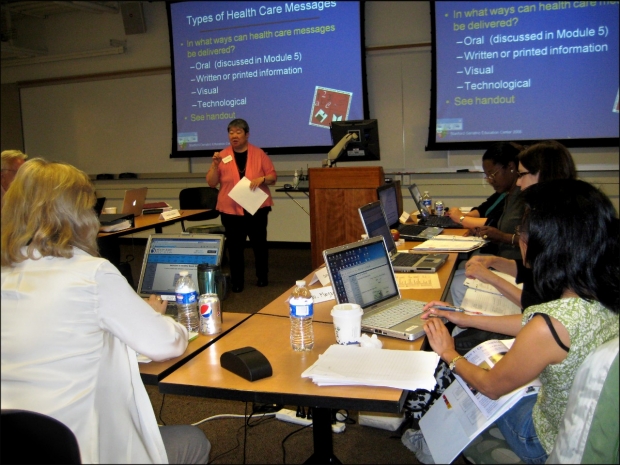
- On-Site Training. An intensive 4-day training in Health Literacy and Ethnogeriatrics (HLE) at the Stanford University School of Medicine. The 8-module core curriculum incorporates didactic sessions, interactive workshops, resource sessions, and other activities.
- Online Training. Web-based ethnogeriatric curriculum modules; multimedia resources; and on-demand webinars on topics such as Ethnicity and Dementia, Care of Diverse Elders and Their Families in Primary Care, and Clinical Ethnogeriatrics.
- Mentoring and Consultation. Individualized mentoring and consulting sessions with the SGEC’s interdisciplinary health care faculty team via required monthly meetings using internet technology.
- Project. The capstone requirement is a project related to ethnogeriatric care at the trainee’s home institution, with SGEC faculty support.
Trainees receive a Certificate of Completion in Ethnogeriatrics from the SGEC at the end of the training.
This training program is the result of a week-long Faculty Development Program in Health Literacy and Ethnogeriatrics (HLE) which began in 2008. A total of 34 faculty trainees participated in the earlier program representing 11 disciplines, 19 institutions, and 12 states. Evaluations of the previous trainings revealed positive outcomes such as curricular change, as well as increased knowledge, attitudes, and skills related to HLE.
For information and application for the 160-Hour SGEC FDPE and other faculty development opportunities, contact Nancy Hikoyeda at .
.Additional SGEC Faculty Development Opportunities
The SGEC is seeking partners for a series of customized multidisciplinary and discipline-specific faculty development programs on a variety of ethnogeriatric topics. Please check this site periodically for announcements and further information.
Our current efforts will focus on a competency-based continuing education program around ethnogeriatric issues for nursing faculty in baccalaureate and graduate nursing programs. We will start with nursing faculty in our service area and expand to other regions in the future. Nurse educators who are interested in participating or need further information may contact .
Evidence Based Practice Training
Diabetes
As part of the SGEC consortium, nurses at the Community Health Partnership clinics at the Gardner Family Health Network (GFHN) are being trained in an Evidenced-Based Practice (EBP) protocol for diabetic care of patients 55+. This protocol will be implemented at five GFHN clinics to increase the number of older adults with diabetes receiving EBP chronic care management:
- Alviso Health Center, Alviso, CA
- CompreCare Health Center, San Jose, CA
- Gardner Health Center, San Jose, CA
- Gardner South County, Gilroy, CA
- St. James Health Center, San Jose, CA
Depression
SGEC provides training for staff of Santa Clara County Department of Mental Health in the following Evidence Based Practices for depression among older adults:
- Training of service providers in the administration and interpretation of a commonly used questionnaire to assess depression (PHQ-9). Following the initial and follow-up training sessions (in person and supported by technology), it is anticipated that the PHQ-9 will become part of the County’s Electronic Medical Record system, which will greatly facilitate its use over time for patient assessment, treatment planning, and monitoring of progress.
- Training of staff in basics of cognitive-behavioral therapy (CBT), a short-term evidence-based treatment for depression. SGEC trainers have developed a modified program to use for late-life depression that is also empirically supported. Staff from the various contracted county clinics apply for admission to the CBT training program, which is 5-month commitment. Providers are selected from a variety of disciplines including social work, psychiatry, marriage and family therapy and psychology. The program is modeled after the Veterans Administration national CBT training program. Didactic and experiential components include small group consultation to develop basic competency in CBT for late life depression.
Clinical Training Programs
Stanford University School of Medicine
Medical students (80-90 per year) from Stanford University School of Medicine participate in clinical training and field work in their 4-week Required Core Clerkship in Family Medicine. They are trained in the Chronic Disease Management Model by Grace Yu, MD and apply this in ambulatory care settings which serve ethnically diverse elders. The curriculum includes teaching on potential barriers for older diabetic patients in following through on their diabetic self-care and strategies for overcoming these barriers. Each medical student is required to develop an action plan with a self–management goal for patients living with a chronic disease. The students are observed and evaluated often during their rotation.
San Jose State University (SJSU) Health Professions-Related Programs
SGEC facilitates ethnogeriatric training of students in a variety of health professions, through both didactic and experiential methods, to work more effectively with older adults and their families in different ethnic communities. Students in six SJSU health professions-related departments/programs including nursing, social work, occupational therapy, nutrition, gerontology/health science, and communicative disorders participate in clinical training/fieldwork in nursing homes, chronic and acute disease hospitals, ambulatory care centers, senior centers, community-based nurse managed centers, and other sites where the provision of health care to ethnically diverse elders is a component.
These academic programs are committed to improving the delivery of health and social services to ethnic elders and to addressing health care disparities found in ethnic communities. Their goal is to: (1) increase the ethnogeriatric knowledge and skills of current and future geriatric health care providers; (2) provide focused ethnogeriatric training in preparation for the clinical/fieldwork requirement; (3) enable supervised clinical/fieldwork experiences for SJSU students placed in geriatric and other aging and health care-related sites throughout the San Francisco Bay Area.
For additional information about the SGEC clinical/fieldwork programs, please contact Nancy Hikoyeda at
.
Webinars
Since 2009, SGEC has been sponsoring an annual webinar series in collaboration with other partners. Many of the recordings have been archived and are available for access at no charge here.
Conferences
Since SGEC was founded in 1987, it has sponsored and cosponsored several hundred conferences, most for multidisciplinary health professionals, and most including information on ethnogeriatrics. We continue to partner with other organizations to meet the need for educational conferences on geriatric and ethnogeriatric topics in the greater San Francisco Bay Area. For future conferences, see the SGEC Calendar of Events. For information on past conferences contact SGEC at .
A conference that has been cosponsored by SGEC annually for 14 years is "Updates on Dementia" developed and offered each spring under the primary leadership of the Northern California & Northern Nevada chapter of the Alzheimer’s Association geared to direct service providers. (See description under SGEC Ethnogeriatric Resources: Dementia and Caregiving)

